The short answer: the Pomodoro Technique and the Flowtime technique disagree about one thing, which is who decides when the work stops. Pomodoro says the timer does: 25 minutes, bell, break, no argument. Flowtime says you do: work until your focus fades, note the time, take a break sized to how long you worked. Flowtime fixes Pomodoro’s worst fault, the bell ringing in the middle of a flow state. It pays for that fix by giving up Pomodoro’s best feature, the fixed edge that gets you started and stops hyperfocus eating the afternoon. You do not have to pick. The method that works for most people I hear from is a soft-edged timer: a fixed duration you commit to, extended on purpose when the flow is real, with the breaks and bookkeeping carried through automatically.
A disclosure up front. I’m the developer of Vitamin-R, a paid Mac focus app whose timing model sits between these two techniques, so I am not a neutral referee. I have tried to make the comparison honest anyway, because people who pick the wrong technique for their work give up on timers altogether, and that helps nobody.
The two techniques in one paragraph each
Pomodoro, devised by Francesco Cirillo in the late 1980s, is a fixed rhythm: 25 minutes of work on one task, a 5-minute break, and a longer break of 15 to 30 minutes after every fourth Pomodoro. The timer is the authority. If it rings mid-sentence you stop. If you are interrupted, the Pomodoro is void and you start another. The numbers are a preset and most people adjust them, but the principle is not negotiable: the clock decides when work stops, so that you do not have to.
Flowtime was written up in 2016 by Zoë Read-Bivens, in a Medium post titled, bluntly, “Abandoning Pomodoros”. Her complaint was that the timer is a tyrant: 25 minutes is often exactly the wrong length, and being pulled out of concentration by a bell costs more than the break returns. Her method: pick one task, write down the start time, work until you feel tired or distracted, write down the stop time, take a break, and record how long it was. She also recommended a column for interruptions, so that over a few weeks you learn what actually breaks your focus. For the breaks she offered a rough scale rather than a rule: about 5 minutes after 25 minutes of work or less, 8 minutes after 25 to 50, 10 minutes after 50 to 90, and 15 minutes after anything longer.
So Flowtime is Pomodoro with the authority moved from the timer to your own sense of fatigue, and the timer replaced by a stopwatch and a notebook. That is a bigger change than it looks.
What Flowtime gets right
The bell really is the problem. Every Pomodoro guide, including mine for ADHD, spends a section on the moment the timer rings while you are mid-thought. It is the single most common reason people tell me they stopped using a timer. Concentration is expensive to build and cheap to lose, and a rhythm that discards it four times an hour on principle has a real cost. Read-Bivens put it well: refreshed work is orders of magnitude better than fatigued work, but work that was going well and got stopped is not refreshed, it is just stopped.
Breaks sized to the work make sense. Five minutes after 25 minutes and five minutes after 90 are not the same break. Pomodoro’s long break every fourth round is a crude version of the same idea; Flowtime’s sliding scale is a better one.
The record is the point. Writing down start, stop, break and interruption turns a timer into an instrument. After two weeks you know how long you can actually concentrate at ten in the morning versus four in the afternoon, which task types drain you fastest, and what your real interruptions are. Most people have never measured any of that. A fixed-length Pomodoro cannot tell you, because every entry reads “25”.
What Flowtime quietly gives up
Starting. This is the big one, and Flowtime guides rarely mention it. The reason a 25-minute box helps you begin a task you are avoiding is that it is bounded: whatever happens, it ends. “Work until you feel tired” has no end, and for a task you dread, an open-ended commitment is exactly the thing your brain refuses to sign. Pomodoro’s fixed duration is not an accident of a kitchen timer. It is the feature that gets you past the first five minutes. Flowtime assumes you are already working and only needs to decide when to stop; Pomodoro assumes you have not started yet. If starting is your problem, and for a lot of people it is the whole problem, Flowtime removes the part of the technique you needed. My guide to task initiation is about that part.
Stopping. “Work until your focus fades” is honest advice for someone whose focus fades gently and noticeably. It is bad advice for someone who hyperfocuses, because their focus does not fade, it simply continues past lunch, past the meeting and past the point of useful output, and the first signal that anything is wrong is a headache at five o’clock. Pomodoro’s bell is clumsy, but it is one of the few things that reliably tells a hyperfocused brain that three hours have passed. Flowtime has no such alarm. Fatigue is a poor timer, because it reports late.
Decisions. Flowtime asks you a question every few minutes: am I still focused? Should I stop now? For some people that question is free. For many it is the leak: every “should I stop?” is a tiny negotiation, and every negotiation is a door for procrastination to walk through. Pomodoro’s rigidity is irritating precisely because it refuses to negotiate, and that refusal is what some of us are paying for.
The bookkeeping. Writing down four times per session sounds trivial. In practice, Flowtime done by hand survives about a week, because the stop time gets forgotten and the interruptions column is the first thing abandoned. The technique’s main benefit, the record, depends on the part that decays fastest. This is a tooling problem, not a flaw in the idea, but it is why most people who “do Flowtime” are actually doing “work until I feel like stopping”, which is what they did before.
Who should use which
- Use Pomodoro, or something with a fixed edge, if you struggle to start, you hyperfocus, your work is made of many small tasks, or you notice that “just deciding” when to stop is where your day leaks. The fixed box is doing real work for you. Shorten it rather than abandoning it.
- Use Flowtime, or something open-ended, if you start easily, your work comes in long indivisible stretches (writing, coding, proofs, design), the bell genuinely costs you more than the break gives back, and you will actually keep the record.
- Most people are both, at different hours. The 9 a.m. version of you, facing a task you have put off for a week, needs Pomodoro. The 11 a.m. version, forty minutes into the same task and finally seeing the shape of it, needs Flowtime. A technique that only serves one of them will be abandoned by the other.
The middle path: a soft-edged timer
The middle path keeps Pomodoro’s fixed duration for what it is good at, starting and bounding, and borrows Flowtime’s permission to keep going for what that is good at, protecting flow. The rules:
- Commit to a duration before you start. Not “until I’m tired”. A number, typed in, with a single objective next to it. This is the Pomodoro half, and it is what gets you moving. When starting is hard, make it five minutes; my timeboxing guide covers how to choose.
- When the timer ends, extend on purpose or stop. If the flow is real and you know what the next stretch is for, add a named amount: ten more minutes, twenty, not “a bit longer”. This is the Flowtime half, and the word that matters is purpose. Extending once by a named amount because you can feel the work going well is a decision. Extending again and again because the bell is annoying is autopilot, and autopilot is how a 25-minute session becomes a four-hour one.
- Keep a hard ceiling. Ninety minutes without a break is the outer edge for almost everyone, and Flowtime’s own break scale agrees. If you have extended twice, the next bell is final.
- Size the break to the work. Use Read-Bivens’s scale or Pomodoro’s long-break rule; either is better than a flat five minutes after everything.
- Let the tool do the record. Start time, stop time, how focused you were, in one click, so that the record exists in week three. If the bookkeeping takes effort it will not happen.
This is, not coincidentally, how Vitamin-R has worked for fifteen years, and the manual says it in its own words: the timing is close to Pomodoro’s, but the app “puts a higher value on flexibility and individual choice rather than rigid adherence to a pre-determined plan”, and “there isn’t much point in forcing yourself to take breaks you really don’t want”. In practice it works like this:
-
You type an objective and a duration, and a countdown runs. That is the Pomodoro half. The manual’s advice on choosing a duration is to start short when you are resisting a task.
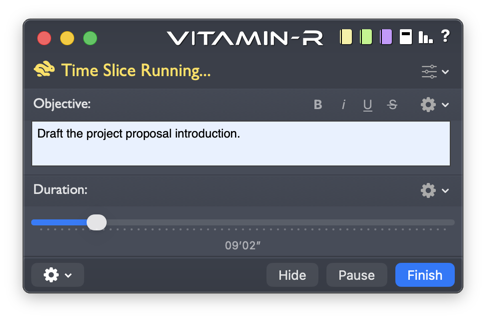
- When the countdown ends, a soft break gives you up to thirty seconds to finish the sentence before the break starts; and if you want more than a sentence, you can add one, three, five or ten minutes from the menu bar or type a new duration, which the manual’s tip on extending time slices explicitly endorses when you have reached a flow state. That is the Flowtime half.
- The hand-offs at the end of a session, logging it, starting the break, setting up the next one, can run themselves on a ten-second countdown with Auto-Forward, so the gaps where Flowtime’s “should I stop?” question lives are closed.
-
Each session ends with a one-click focus rating, and the statistics show, by hour and by weekday, where your focus actually was. That is Flowtime’s notebook, filled in without a notebook.
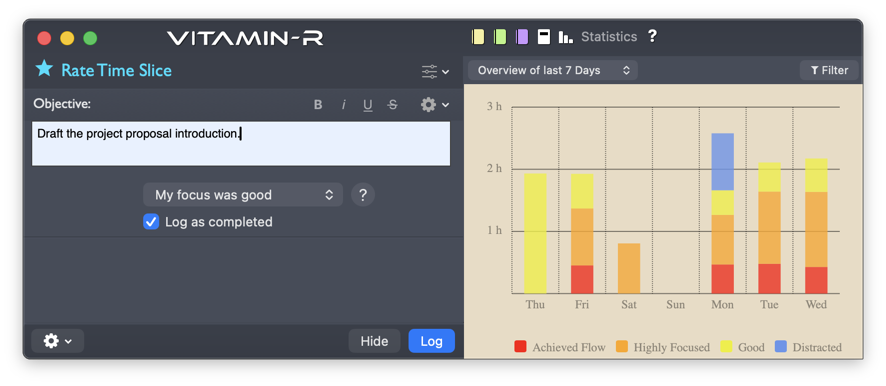
You can do all of this with a kitchen timer and a spreadsheet, and if that works for you, keep the money. The point of the tool is that the extension is a deliberate click rather than a drift, and the record keeps itself.
The cousins: 52/17 and 3-3-3
Two other rhythms come up in the same searches and are worth placing.
52/17 comes from a 2014 analysis by DeskTime, a time-tracking company, of its own most active users: the top 10% worked in stretches of about 52 minutes and then broke for about 17. When DeskTime repeated the exercise in 2021 the numbers had moved to 112 minutes on and 26 off. Treat it as an observation about one vendor’s users, not a prescription; its real lesson is the same as Flowtime’s, that productive people work longer than 25 minutes at a stretch and take longer breaks than 5.
3-3-3 is a day shape rather than a session shape, usually attributed to the writer Oliver Burkeman: three hours on your most important project, three shorter tasks, three maintenance chores. It says nothing about how to run the three hours. Pomodoro, Flowtime or the middle path all fit inside it.
FAQ
What is the Flowtime technique? A time-management method, proposed by Zoë Read-Bivens in 2016 as an alternative to Pomodoro, in which you pick one task, note the start time, work until your focus fades rather than until a timer rings, note the stop time, and take a break scaled to how long you worked. You also record interruptions, so that the log shows your real attention span and your real distractions.
Is Flowtime better than Pomodoro? It is better for protecting flow and worse for starting and for stopping. If you begin tasks easily and work in long stretches, Flowtime will suit you. If you procrastinate, hyperfocus or do many small tasks, Pomodoro’s fixed edge is doing work you need. Most people are helped by a timer with a fixed duration that can be extended on purpose, which takes the best of both.
How long should a Flowtime break be? Read-Bivens’s guidance is roughly 5 minutes after up to 25 minutes of work, 8 minutes after 25 to 50, 10 minutes after 50 to 90, and 15 minutes after more than 90. It is a scale, not a rule.
Does Flowtime work for ADHD? Mixed. The flexibility helps people whom the bell drove away from timers. But the two things ADHD brains most often need from a timer, a bounded start and a hard stop for hyperfocus, are the two things Flowtime removes. My guide to the Pomodoro Technique for ADHD describes a modified rhythm that keeps both. I am a developer, not a clinician, and none of this is medical advice.
What is the difference between Flowtime and the 52/17 rule? 52/17 is a fixed ratio, like Pomodoro with longer numbers, taken from a 2014 DeskTime study of its most active users. Flowtime has no fixed numbers at all; you stop when your focus fades and size the break to the work.
Can I use a Pomodoro app for Flowtime? If it lets you extend a running session and keeps a log, yes: set a duration, extend it when you are in flow, and let the app record the real length. If it only runs a fixed 25 minutes, you are better off with a stopwatch. If you do not have one yet, my comparison of Pomodoro apps for the Mac covers the main options.
Written by Frank Reiff, developer of Vitamin-R, a focus and timeboxing app for the Mac from publicspace.net, which has made Mac software since 1996. See also my guides to timeboxing, the Pomodoro Technique for ADHD, the best Pomodoro apps for Mac and deep work on a Mac.