The short answer: task initiation is the ability to begin a task when it needs beginning, without waiting for a deadline, a mood or a rescue. With ADHD it is frequently the hardest part of the whole job: once started, the work often goes fine, but the gap between knowing what to do and doing the first thing can swallow a morning. The way round it is not more willpower. It is to make the first step so small and so explicit that it never registers as a threat: five minutes, one line, a finish you can see from here. Starting is a separate skill from working, and it responds to a separate technique.
A disclosure, and a caveat. I’m the developer of Vitamin-R, a paid Mac focus app, so I have an interest in people solving this problem with a timer. I’m also not a clinician, and nothing on this page is medical advice. What follows is a working model of why starting is hard and a method that people with ADHD have told me, over fifteen years, gets them moving. Treat the model as a useful way to think about it, not as neuroscience, and the method as something to try, not a treatment.
What task initiation is, and what it is not
Task initiation is one of the executive functions, the set of mental skills that organise behaviour towards a goal: planning, working memory, impulse control, shifting attention, and starting. It is the skill of converting an intention into a first action at the moment the action is due. People with strong task initiation do not notice they have it. People without it notice it constantly.
It is worth separating it from two neighbours it gets confused with.
- Procrastination is a choice, however unhappy. You know what to do, you could do it, and you do something else instead. Weak task initiation is different in kind: you want to start, you have cleared the desk to start, you are sitting in front of the thing, and the start does not come. The “I don’t want to” and the “I can’t” feel alike from outside and completely different from inside.
- Task initiation paralysis, a term that has grown up in ADHD communities, is the extreme end: not just failing to start one task, but being unable to start anything, often while being fully aware of the time passing. It usually arrives when the list is too long or the first item is too big, and it is the state the method below is designed to prevent rather than cure.
Do people with ADHD struggle with initiating tasks? Yes, commonly, and it is one of the most reported difficulties among adults with ADHD, more than staying on task once started. That ordering matters. Most productivity advice is about sustaining attention. If your problem is the first minute, advice about the next sixty is beside the point.
Why starting is harder than continuing
Here is the model I find most useful, which comes from the manual for my own app, in its topic on finding the right time slice duration.
Deep in the brain is a fast, crude alarm system whose job is to keep you alive. It does not evaluate threats carefully; it has no time for that. It reacts to anything that looks like it could hurt, and it reacts the same way to a stranger in a dark alley and to a looming piece of work that could go wrong, take forever or expose you. The reaction is to make you avoid the thing, immediately, and to make everything else feel more urgent than it is. Cleaning the kitchen suddenly becomes essential.
“Write the quarterly report” trips this alarm. It is big, it is vague, it has no visible end, and the stakes feel high. “Spend five minutes writing down five things that should be in the report” does not trip it. It is small, it is explicit, it ends in five minutes, and nothing bad can come of it. The work it leads to is the same report. The alarm cannot see that far.
Two things seem to make this worse with ADHD. First, the alarm is louder and less discriminating: more tasks look threatening, and the avoidance response is harder to override by deciding to. Second, ADHD attention is driven by interest, novelty and urgency rather than by importance, so the sensible reason to start (“it is due Friday”) has very little pull until Friday is tomorrow, at which point the urgency finally supplies what the importance could not. That is why so many people with ADHD do their best work in a panic, and why they are exhausted by it.
The model explains the other thing everyone with ADHD reports: once started, it is usually fine. Momentum does the work the alarm was blocking. The task that was impossible at nine in the morning is absorbing by half past. The whole difficulty was in the first few minutes, which means the whole solution can be aimed there too.
The stealth task: a first step the alarm cannot see
The manual’s word for a first step designed to slip past the alarm is a stealth task. Its recipe has five parts, and all five matter.
- Its purpose is to get you started, not to get the job done. You are not trying to make progress on the report. You are trying to be, five minutes from now, a person who is working on the report. Progress follows from that; it is not the goal of the stealth task.
- Tiny scope. One action, not a phase of the project. If it has sub-steps, it is too big.
- Explicit wording. Written down, in a sentence, in words that describe an action you could watch yourself doing. “Look at the report” is not an action. “Open last quarter’s report and copy its section headings into a new document” is.
- A reachable finish line. You should be able to tell, without judgement, whether it is done. Five headings copied: done. “Make a start on the report”: undecidable, and undecidable means un-startable.
- A few minutes. Five is the usual number. Short enough that the commitment is trivial, long enough to get the first real motion going. If five feels like a lot, it can be two.
Some pairs, bad first and good second, because the difference is easier to see than to describe:
- “Do my taxes” becomes “Find last year’s return and put it on the desk. 5 min.”
- “Start the thesis chapter” becomes “Open the chapter file, type the heading and one deliberately bad first sentence. 5 min.”
- “Sort out the inbox” becomes “Archive everything older than a month without reading it. 5 min.”
- “Fix the login bug” becomes “Reproduce the bug once and write down the exact steps. 5 min.”
- “Clean the flat” becomes “Clear the kitchen table. 5 min.”
- “Prepare for the review meeting” becomes “Write three questions I want answered in the meeting. 5 min.”
Notice that none of the good versions is the task. Every one of them is a door into it. That is the point. The alarm guards the task; it does not guard the door.
Writing the line
The practical form is one line: what, then how long. Write it before anything else, and write it down rather than thinking it, because a thought is negotiable and a line on the desk is not. Present tense, one action, a number of minutes.
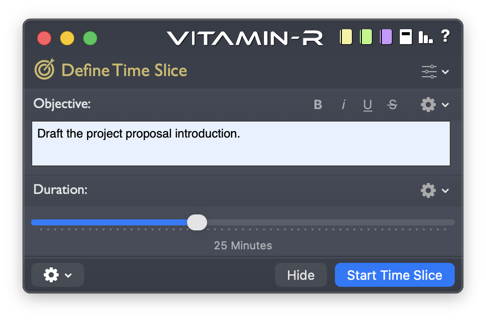
That line is also, not by coincidence, what a timer app asks you for. Vitamin-R starts every session, which it calls a time slice, with a screen that asks for one objective and one duration, and will not start the clock until both are there. People with ADHD tell me that the forcing function is the point: the app will not let you start vaguely, so you cannot.
When even five minutes will not start
The recipe does not always work the first time, and the failure modes are predictable.
- Shrink it again. If “put last year’s return on the desk, 5 min” still will not start, the alarm is still seeing something. Make it “find the folder, 2 min”. There is no step too small to count. The smallness is not a trick you are playing on yourself; it is the method.
- Make the objective “decide”. Some mornings the problem is not any one task but the choice between them. Then the stealth task is “spend five minutes choosing the first real task and writing its objective”. You have made a start, and the start was choosing.
- Decide the night before. The worst moment to pick the first task is the moment you are supposed to start it, because that is when the alarm is loudest. Write tomorrow’s first line tonight, when the task is abstract and harmless. In the morning you are not deciding, only reading.
- Change something physical. A different chair, a different room, standing up, a glass of water on the desk. It sounds trivial. The alarm is partly reacting to the place where the dread lives, and moving the body moves the place.
- Borrow a witness. Many people with ADHD find that starting next to another person who is also working, in a room or on a video call, gets them over the line when nothing else does. The ADHD community calls this body doubling. I have no data on why it works, only a great deal of testimony that it does.
- Keep the list short. A long to-do list is its own initiation problem: every item is a threat, so none of them gets started. Cap the day. One big thing, a few medium ones, a handful of small ones, and nothing else on the page.
What does not help is the thing most people try first: telling yourself off. The alarm reads shame as a threat too. If the morning has gone, the useful response is a two-minute stealth task, not a reckoning.
Once you are moving
The starter session ends after five minutes, and this is the moment that decides the day. Three things to do with it.
Keep going if you want to. If you reach the end of the five minutes and want fifteen more, take them. Extending a starter session is not a failure of discipline; it is the stealth task doing precisely what it was for. Name the amount, add it, and carry on. My guide to the Pomodoro Technique for ADHD goes into when extending a session is a decision and when it has become autopilot.
Set the next line before the break. If you stop, write the next session’s objective before you stand up, not after you sit down. The gap between sessions is the second place the alarm can get you, and the way to close it is to never arrive at an empty “what now?”. In Vitamin-R the transitions can be automated with Auto-Forward, so the next session’s setup appears on its own.
Park what arrives. The moment you are finally moving is the moment the brain produces every other thing you could be doing. Write each one on a list you will look at in the break, and do nothing about it now. Vitamin-R’s note pads exist for this; a sheet of paper works too.
Here is what a morning with a weak start looks like when the method is working:
- Read tonight’s line. It was written last night. “Open the chapter file, type the heading and one bad sentence. 5 min.”
- Start the five minutes. Timer on, line in front of you. Do the thing on the line and nothing else.
- At the end, choose. Keep going by a named amount, or write the next line and take a short break.
- Second session, 15 to 25 minutes, with a real objective. This one starts easily because you are already working.
- Everything else that occurs to you goes on the list. Deal with it at lunch.
Four or five sessions after a five-minute start is a good day for anyone, and a transformed one for someone whose mornings used to go to the alarm.
Tools
You need a way to write one line and a way to count five minutes. Paper and a kitchen timer do it, and the free Clock app on a Mac counts the minutes. If you are going to try the method, start there.
Where an app helps is in making the method the path of least resistance. Vitamin-R asks for the line and the minutes before it will start, lets you type both as one phrase and have it parsed into an objective and a duration, keeps the list for intruding thoughts a keystroke away, and carries you through the transitions. It is a one-time purchase with a free trial. My guide to focus apps for ADHD on a Mac looks at the whole category, including the free options, and says plainly when a free timer is all you need.
FAQ
What is task initiation? The ability to begin a task when it needs beginning, without an external push such as a deadline or another person. It is one of the executive functions, alongside planning, working memory and impulse control, and it can be weak in someone who is otherwise highly capable.
Is task initiation an executive function? Yes. It is usually listed with the others: planning, organisation, working memory, self-monitoring, emotional control, flexibility and sustained attention. ADHD affects executive function broadly, and initiation is among the most commonly reported problems in adults.
Do people with ADHD struggle with initiating tasks? Very commonly, and often more than with sustaining attention once started. That is why advice about staying focused frequently misses the point: the difficulty is in the first minute.
What is task initiation paralysis? The state of being unable to start anything at all, usually while fully aware that time is passing. It tends to follow from a list that is too long or a first task that is too big. The method on this page is aimed at preventing it: one tiny, explicit first step, chosen in advance.
What is the 1-3-5 rule for ADHD? A way of capping the day’s list: one big task, three medium tasks and five small ones, and nothing else. It is a planning rule rather than a clinical one, and its value for task initiation is that a short list contains fewer threats than a long one. Pair it with a five-minute stealth task for the one big item.
Is this the same as procrastination? No. Procrastination is choosing something else over a task you could start. Weak task initiation is wanting to start and finding that the start does not come. They look the same from outside and feel entirely different from inside, and the second one responds to structure rather than to resolve.
Does medication help with task initiation? That is a question for a clinician, not for a software developer. What I can say is that the method here is scaffolding, and scaffolding works alongside whatever else you are doing, including nothing.
Is this medical advice? No. It is a developer’s working model and a method that people with ADHD have told me helps. For diagnosis and treatment, talk to a qualified professional.
Written by Frank Reiff, developer of Vitamin-R, a focus and timeboxing app for the Mac from publicspace.net, which has made Mac software since 1996. See also my guides to the Pomodoro Technique for ADHD, focus apps for ADHD on a Mac, timeboxing and deep work on a Mac.