Applies to macOS Ventura through macOS 26
The short answer: yes, videos can be geotagged, and it’s worth doing: a MOV or MP4 with a location shows up on the map in Photos and Google Photos next to the stills from the same day. The location lives in the video container’s own metadata, not in EXIF, which is why image-centric tools don’t see it and why video editors throw it away on export. Phones write it; cameras almost never do. On a Mac you can assign a location in Apple Photos (it stays in the library), write it into the file with ExifTool, or drop a pin on a map and apply it to a batch of clips and photos together with a dedicated editor.
A disclosure: I’m the developer of Media Location Tagger, the dedicated editor in the last of those routes. The others are covered first.
Boundary checks:
- You want to add a location to photos → the photo geotagging guide; this one is the video-specific companion.
- The video has a location and it’s wrong → the same fix as for photos, described in the manual; everything below about where the location lives applies.
- You want the location taken out of a video before sharing → the remove-metadata guide covers videos too.
If coordinates versus place names, and file versus library, are new to you, the geotagging explainer is the five-minute background; this guide assumes it.
Where a video keeps its location
A photo stores its coordinates in EXIF: separate latitude and longitude tags, unsigned, with the
hemisphere in a reference tag. A MOV or MP4 file has no EXIF. It stores its location as one string in
the container’s metadata, in the ISO 6709 form +55.3430+011.0300+044.321/: signed latitude,
signed longitude, optional altitude. On an iPhone clip that string sits under the key
com.apple.quicktime.location.ISO6709, which ExifTool reports as Keys:GPSCoordinates. Older
phones and some cameras used an earlier atom for the same thing (ExifTool’s
UserData:GPSCoordinates), and an MP4 that has been through Adobe software may carry a third copy in
an XMP packet. Software disagrees about which of these to read, so a file can be “located” in one
app and blank in the next.
Three consequences follow:
- Image tools miss it. Anything that looks for EXIF GPS reads a video and finds nothing, and
anything that writes EXIF-style tags into a video writes them somewhere the video players don’t
look. (ExifTool’s bare
-GPSLatitudeon a MOV lands in XMP, which Photos ignores.) - There are no IPTC fields in a video. City, state and country can only go into an XMP packet embedded in the file, which Lightroom and Bridge read and Photos doesn’t. Coordinates are the useful part for video; the place-names guide covers the rest.
- A GPS track is not a location. GoPro, DJI and Insta360 footage carries per-second GPS telemetry in a data track alongside the video, which is a different thing from the single container-level location above. Photos and Google Photos don’t read the telemetry track, so an action-camera clip doesn’t appear on their maps until a container-level location is written as well.
Who writes it, who reads it, and where it gets lost
Writes it: iPhone and iPad, on every clip, as long as the Camera app has Location Services access. Android phones, when the camera app’s location tag setting is on (it often isn’t). Almost no dedicated camera: the few bodies with a GPS receiver write it to stills, and the Bluetooth phone-app links do the same, so the MP4 from a Sony, Canon or Nikon body has no location even on a day the photos have one.
Reads it: Photos puts a located video on the map and in the Places album and shows the location in its Info panel; Google Photos does the same after upload. QuickTime Player, VLC and the Finder’s Get Info panel show nothing, whether the location is there or not, which is the first thing to know when checking. The reliable way to look is ExifTool:
# every copy of a video's location, with the group each one lives in
exiftool -a -G1 -s -Keys:GPSCoordinates -UserData:GPSCoordinates -ItemList:GPSCoordinates \
         -XMP:GPSLatitude -XMP:GPSLongitude clip.mov
Loses it: every video editor, more or less. iMovie, Final Cut Pro, Premiere, DaVinci Resolve, CapCut and HandBrake write a new container on export and, by default, don’t copy the source clip’s location into it. Messaging apps re-encode and strip. Photos keeps what the original had when you Export Unmodified Original; for its standard export of an edited clip, check the copy with the command above rather than assuming. So the rule for tagging is: tag the file you’re going to keep, which is usually the final export, not the source clips.
Route 1: Apple Photos (free, into the library)
Photos treats a video like a photo for location purposes. Select the clip, or the whole day’s clips and photos together, press ⌘I, click Assign a Location and type a place. The videos get the pin, appear on the map, and sort into Places.
As with photos, this changes the library, not the file. The MOV in the library folder still has no location, and neither does a copy you make of it, an Export Unmodified Original, or a file a client opens after AirDrop. If the library is where the videos will live, that’s fine. If the files go anywhere else, use one of the routes that write into the file.
Route 2: ExifTool (free, command line)
ExifTool writes the QuickTime location key directly. The value is signed decimal degrees, comma-separated, with an optional altitude in metres; there are no separate hemisphere tags, so south and west are simply negative:
# one clip: latitude, longitude, altitude (altitude optional)
exiftool -Keys:GPSCoordinates="55.3430, 11.0300, 44" -overwrite_original clip.mov

# every MOV and MP4 in a folder, same spot
exiftool -Keys:GPSCoordinates="-33.8568, 151.2153" -ext mov -ext mp4 -overwrite_original /path/to/folder

# remove it again
exiftool -Keys:GPSCoordinates= -UserData:GPSCoordinates= -overwrite_original clip.mov
Three things to get right. Write to Keys:, explicitly: that is the atom Photos reads, and the
bare tag names resolve to XMP on a video. Keep the sign: -33.8568, 151.2153 is Sydney, 33.8568,
151.2153 is the Pacific east of Japan. And expect ExifTool to rewrite the whole file, because the
metadata atom sits at one end of a container that can be many gigabytes; on a slow disk a folder
of 4K clips takes a while, and there’s no preview of what’s about to happen.
Route 3: Media Location Tagger (into the file, with a map, clips and photos together)
Media Location Tagger treats a MOV or MP4 as one more row in the file table, next to the JPEGs and RAW files from the same day, and writes the location where the video players look. Nothing changes until you press Apply.
- Drop the clips on the window, on their own or mixed with the day’s photos. The GPS column shows what each file has: green ticks for the iPhone clips, grey “no data” icons for the camera’s MP4s and for the editor’s exports.
- Find the place on the map. Type it into the map’s search field the way you would in Apple Maps, a landmark, a town or a street address, pick it from the suggestions, and the map moves there. Or, if an iPhone clip or photo from the same spot is in the batch, select it and click Add Pin next to its coordinates: the pin lands exactly where the phone was.
- Drop a pin on the spot. The sidebar shows its coordinates.
- Select the clips taken there, with the usual click, shift-click and ⌘-click, and press Apply next to the coordinates. The location is written into every selected file, video or photo, in the form each format needs, and the column turns green.
- Next location. One pin per stop; the arrow buttons step through them.
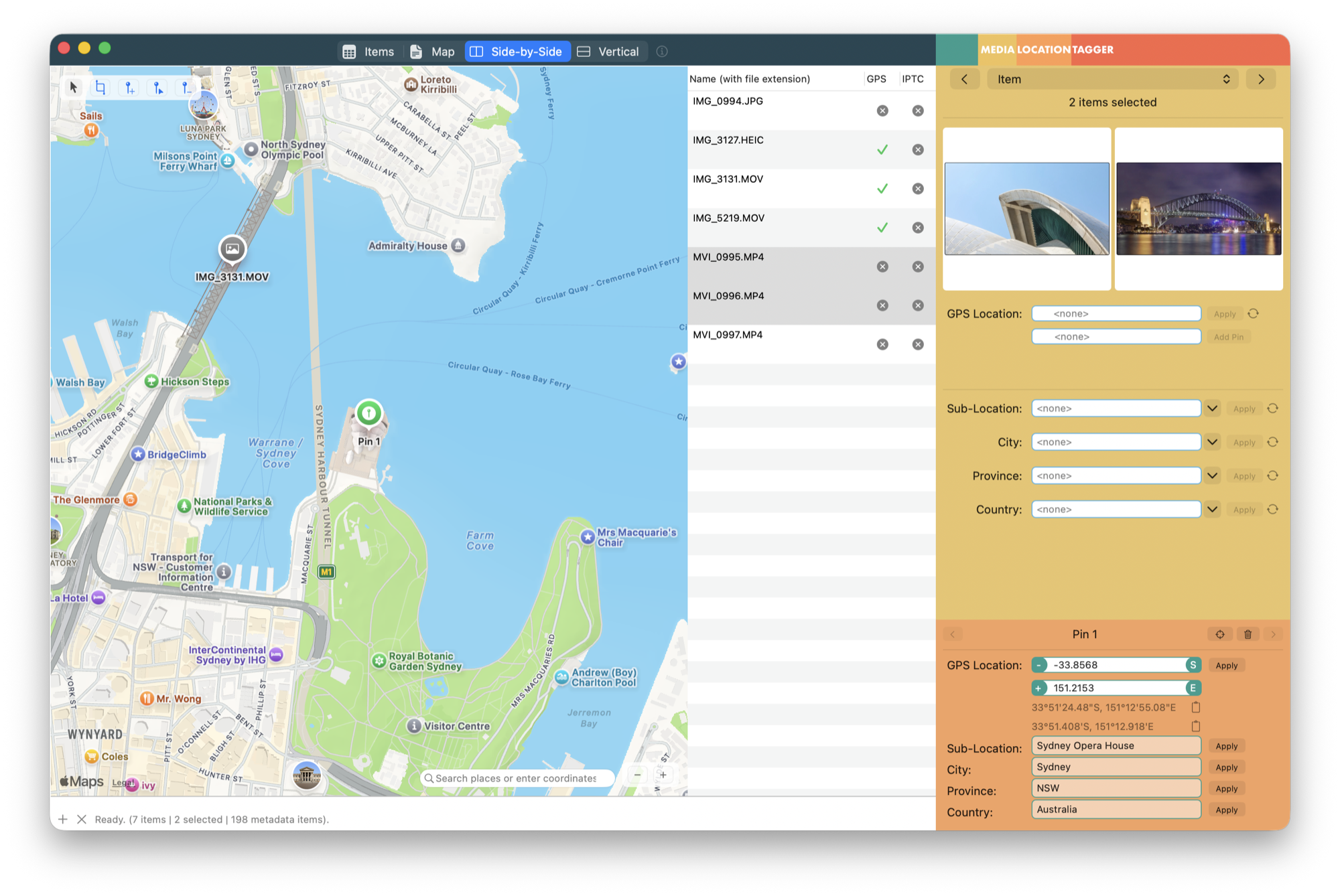
Camera clips and iPhone clips in one batch; the pin comes from the map or from an iPhone clip’s own coordinates.
What it does that the routes above don’t:
- Writes the right atom, and clears the stale ones. The location goes into the modern QuickTime key with any existing altitude carried over, and the older location atoms are cleared in the same write, so no player finds an out-of-date copy. If the file carries an XMP packet, the XMP coordinates are updated too.
- Photos and clips in one pass. A day’s shooting is usually both. One pin, one selection, one Apply, and the JPEGs get EXIF, the RAW files get EXIF, the MOVs get the QuickTime key.
- It shows you first. Every located file is on the map before you touch anything, so the camera clips with no location and the editor export that lost its location are visible as gaps next to the phone clips that have one.
- Place names, if you want them. City, state and country go into the video’s XMP packet for Lightroom, Bridge and DAM systems; Photos won’t show them, and you can skip them for video without losing anything on the map.
Formats: MOV, MP4, M4V, 3GP and the rest of the QuickTime family, including Insta360 INSV and
GoPro LRV files, alongside JPEG, HEIC, TIFF, PNG and the RAW formats. AVI, MKV, WebM and MTS are
read-only: their metadata is shown but they are skipped with a notice when you apply, because
ExifTool can’t write location into those containers. The way round it is to remux the clip into MP4
without re-encoding (ffmpeg -i clip.mkv -c copy clip.mp4) and tag the MP4. It runs on macOS 13.5
Ventura or later, is US$29.95 / €29.95 as a one-time purchase, and has a free trial. The manual
page for videos walks through the same steps with
the app’s own labels.
Common pitfalls
- Tagging the source clips, then exporting. The export has no location; tag the export. (Or tag both: the source clips for your archive, the export for sharing.)
- Writing EXIF-style tags into a video. They go into XMP, Photos doesn’t look there, and the clip stays off the map. Write the QuickTime key.
- The hemisphere sign. Video coordinates are signed. A dropped sign puts the clip off West Africa or in the Pacific. Map-pin tools avoid this; typed coordinates don’t.
- Assigning in Photos and expecting the file to change. It doesn’t; see Route 1.
- Expecting a GoPro clip to map itself. The telemetry track isn’t a location. Write one.
- AVI and MKV. No place to put the location; remux to MP4 first.
- iCloud placeholders. A Photos library or iCloud Drive folder set to optimise storage holds stubs for large videos more often than for photos. Download the original before tagging it.
- Messaging apps. WhatsApp, Messages and the like strip the location from what they send. Anything that arrived that way has no location to find; the sender’s original has it.
FAQ
Can you geotag a video? Yes. MOV and MP4 files carry a single location in the container’s metadata. Phones write it automatically; for any other clip it can be added afterwards with a tool that writes the QuickTime location key.
Does an MP4 have GPS metadata? It can. The container has a standard place for one location (the ISO 6709 string), which iPhone and Android clips fill in and camera or editor output usually leaves empty.
How do I see a video’s location on a Mac? Photos shows it in the Info panel (⌘I) and on the
map. Outside Photos, ExifTool’s -Keys:GPSCoordinates is the reliable check; QuickTime Player and
the Finder don’t show it.
Why doesn’t my video show up on the map in Photos? Because the file has no container-level location: it came from a camera without GPS, was exported from an editor, or arrived through a messaging app. Assign one in Photos (library only) or write one into the file.
Does iMovie or Final Cut Pro keep the location when exporting? Not by default. Tag the export afterwards.
How do I geotag videos in bulk? Group them by place and apply one location per group: ExifTool with a folder path, or a map pin applied to a selection in Media Location Tagger. Photos handles a multi-selection but only inside its library.
Can I add a location to a GoPro or drone video? Yes, the same way. The telemetry track stays as it is; the container-level location you add is what Photos and Google Photos use for the map.
Does adding a location re-encode the video? No. The image and sound data are untouched; the file is rewritten so the metadata fits, but the picture is exactly what it was.
Frank Reiff is the developer of Media Location Tagger, A Better Finder Attributes and A Better Finder Rename, Mac file-management utilities in continuous development since 1996. Related: How to geotag photos on a Mac, What is geotagging?, How to remove metadata from photos and videos, or get in touch with a location-metadata problem this guide doesn’t cover.